


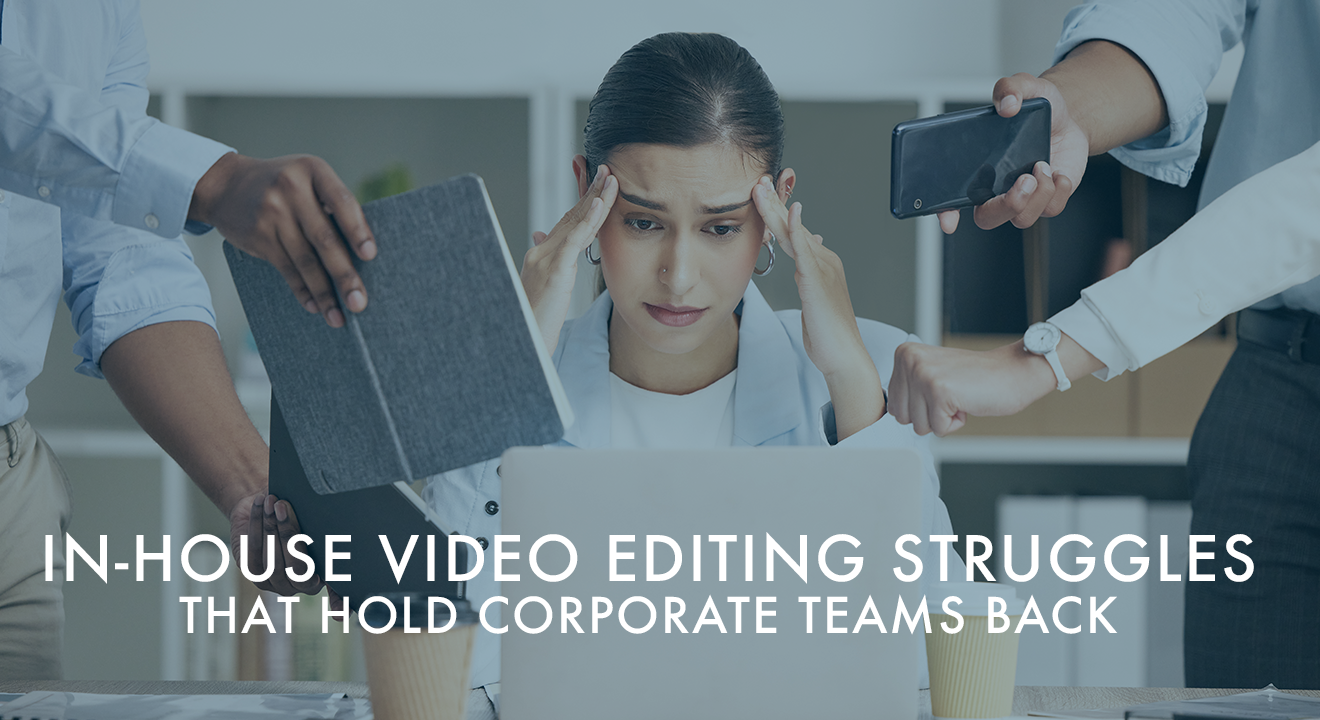

In-house video editing struggles happen more often than most corporate teams admit. Having been in the media business for nearly 26 years, it has been seen time and again. Company X brings on a skilled marketing manager, buys a camera, maybe even a nice editing laptop, and assumes video is covered. It looks efficient at first, but after a few weeks, a bottleneck begins to form. As a business owner, I totally get it. It makes more sense to have a person on deck whenever video needs to be produced. Plus, having someone on payroll can be far less expensive in the short term than hiring a video agency. But here’s the rub.
Over the past 15 years, while working as a filmmaker and commercial production partner, many companies were watched as they attempted to handle video production in-house with the honest goal of being more efficient. Eventually, creative employees were pulled in several directions, supporting multiple teams across the company, and burnout started to set in. Some teams managed for a while, but unless the company is media based, more money is usually spent on video while fewer meaningful results are achieved.
So let’s look at why this happens.
The Real Cost Behind In-House Video Editing
When businesses choose to handle video editing internally, the intentions are usually good. More control is desired. Faster results are expected. Money is supposed to be saved. But editing workflows inside companies rarely stay simple for long. Demands begin piling up, and once a creative employee proves what they can do, they are often overloaded with unnecessary tasks. CEOs have even been known to ask in-house editors to cut personal vacation videos. It sounds crazy, but it happens.
Unless editing has been done firsthand, the time investment can be underestimated. Even a two minute brand video can take days to assemble properly. Once motion graphics, text overlays, color correction, sound design, and revisions are added, timelines stretch quickly. If editing is being handled by someone who is also managing social media, writing copy, coordinating campaigns, and attending meetings, falling behind becomes almost inevitable. As a result, quality is often reduced.
In-house video editing struggles begin quietly. Deadlines are pushed. Revisions are stacked up. Last minute requests are made by internal stakeholders, and schedules get derailed. Marketing momentum is slowed. Teams feel overwhelmed. Eventually, people leave.
Despite advances in AI editing software, human intervention is still required. Editing is more than cutting clips together. Story has to be shaped. Rhythm must be found. Creativity needs space to breathe. When that energy is divided across too many tasks, the final product reflects it.
When In-House Video Editing Hits a Creative Ceiling
Another issue with in-house video editing struggles is skill stagnation. Editing software evolves constantly. Trends shift. Platforms update their preferred formats. What worked six months ago can already feel outdated.
Money is required for training. Time is needed for experimentation.
Rarely does a small marketing team have the flexibility to dedicate hours each week to advanced color grading or motion graphics refinement. Meanwhile, audiences are being exposed to increasingly cinematic content every day. Expectations continue to rise.
The craftsmanship behind professional editing is often underestimated. Adobe, for example, regularly publishes insights on evolving creative workflows and production trends that show how rapidly tools and audience expectations are changing. Staying current is practically a full time commitment.
When editing is handled internally without consistent development, the work eventually plateaus. Videos start to feel repetitive. Engagement declines. Leadership begins questioning whether video is delivering results.
The problem is rarely the video itself. It is the system behind it that needs attention.
Operational Bottlenecks Caused by In-House Video Editing Struggles
Marketing departments move quickly. Campaigns overlap. Product launches stack up. Social content demands constant output. When post production is limited to one or two in-house editors, everything is funneled through a single narrow channel.
At that point, in-house video editing struggles become operational problems rather than creative ones.
A backlog is created. Projects wait their turn. Urgent tasks push everything else aside. Burnout begins creeping in. Because editing is often viewed as technical instead of strategic, it is squeezed into already overloaded schedules.
Companies have been worked with where one editor was responsible for social clips, testimonial videos, internal communications, and conference recaps all within the same week. That pace cannot be sustained.
Once editing becomes a bottleneck, marketing performance inevitably drops.
The Hidden Financial Impact
Ironically, attempts to save money often result in greater long term expense. In-house video editing struggles create inefficiencies that may not immediately appear on a balance sheet.
Consider the time cost. If a marketing director spends five additional hours revising an edit because the workflow lacks clarity, that labor carries value. Multiply that across weeks and months and the expense becomes significant. If a campaign launch is delayed, exposure is lost. If a mediocre video fails to convert, revenue is impacted.
Equipment costs accumulate as well. Software subscriptions renew. Storage expands. Hardware is upgraded every few years. All the while, internal teams remain responsible for maintaining consistency and output quality. Outsourcing does not remove expense, but chaos can be converted into structure and predictability.
Why Professional Editing Support Fixes
Yes, this may sound biased coming from a production company. That bias, however, has been built over two decades of experience. Editing is a demanding process, especially for organizations that do not make media their core business function. Even within our own company, internal marketing edits can become overwhelming.
When companies move beyond in-house video editing struggles and collaborate with an external post production partner, noticeable changes occur. Investment may increase, but strategic focus is regained. Internal teams are allowed to concentrate on messaging, data, and business direction. Editors are allowed to concentrate on craft.
Experience across industries is brought to the table by a dedicated editing partner. Patterns are recognized. Pacing is refined. Narratives are shaped so that brand videos feel intentional rather than pieced together.
Filmmaking has heavily influenced how post production is approached in our company. Patience is taught through feature editing. Discipline is developed. Every frame is considered. That mindset carries into commercial work. Creativity is not rushed. Love for the craft is brought into every project.
Long term relationships also allow systems to be established. Brand guidelines become internalized. Visual consistency is maintained. Fewer revisions are required because expectations are aligned early.
In-house video editing struggles often stem from fragmentation. Professional support creates cohesion.
When It Makes Sense to Keep Editing Internal
Not every company needs outsourcing. Simple and occasional video needs can be handled effectively in house. A small business producing casual social updates may not require a cinematic approach.
However, when brand authority, lead generation, or investor confidence depends on video performance, stakes are elevated. In-house video editing struggles then shift from inconvenience to risk.
Capability is rarely the issue. Allocation of time and focus is.
A Better Way Forward
The goal is not replacement of internal teams. Strengthening them is the objective. The most successful collaborations happen when strategy remains in house while execution is supported externally.
A hybrid model reduces in-house video editing struggles without sacrificing brand voice. Room is created for experimentation. Output increases. Burnout is minimized.
Most importantly, video becomes an asset instead of a source of stress.
If your marketing team feels overwhelmed by revisions, tight deadlines, and inconsistent results, it may be time to reconsider how editing is structured.
If you would like to explore how a dedicated post production partner could support your team, reach out through our contact page and let’s talk about what that could look like for your company:
Keep filming. Keep making movies. Peace Out!
-Kelly